


Road to independence
- Aug 20, 2023
- 9 min read
Updated: Nov 15, 2023

"Only the brave win independence" - Zelensky
On the occasion of the Independence Day of Ukraine, I decided to write a historical article about Ukraine's way to independence, not only to bring you closer to the history of Ukraine, but also to clear up some. In this article you will read only the most important information, and for your convenience, unclear terms will be explained.
Before you start reading this newspaper, I would like to tell you that this newspaper was written only to familiarise you with the history of Ukraine. The information in this newspaper comes from a variety of sources in English, German and Ukrainian, which I have read and processed to write this material to familiarize you with Ukraine's path to independence. You can also verify all the information using your own sources. I wish you a pleasant reading and see you in the next issue of my newspapers
Kiev began its existence in the year 482

According to the legend, at the end of the fifth and the beginning of the sixth century AD, according to the Nestochronic (the oldest East Slavic chronicle), three brothers - Kyj, Shchek and Choryv - together with their sister Lybid built a castle on the hill and above the Dnipro. The town was founded. In honor of the elder brother it was called Kiev. As for all legends, here there is no proof. What is certain: In the Old Slavonic chronicle "Narrative of the Years of Time" the first mention of Kiev refers to the end of the year 482.
Is Kiev really the "Mother of Rus Cities"?
Russian propaganda influences not only its own population, but also other states. An important "justification" for years of Russian aggression against Ukraine is that they call Kiev the "mother of Russian cities". They confirm this with the old chronicle "Narrative of the Years of Time". When the Chronicle mentions the people "Rus'" (In Chronicle also described "Kiev the mother of Rus cities"), the refers to the native population of Kiev as "Rus". The idea of a Russian people was unknown at that time. The first mention of "Moscow" as "the place of Kuchkovich boyars" is mentioned in the chronicle only in 1147.
Is Kievan Rus Russia?
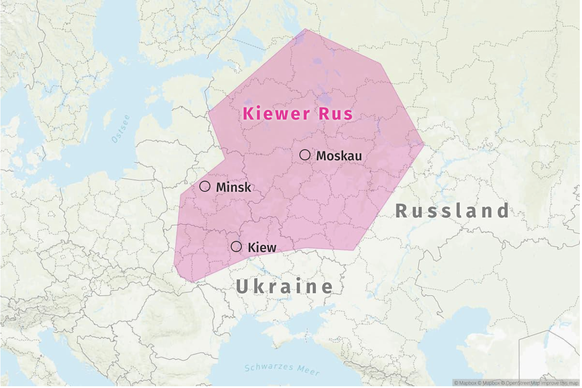
Some people think that Kievan Rus was the Russian Empire, but it was not. Kievan Rus developed from the 9th to the 13th century and included the territories of today's Belarus, Ukraine and other countries. An example of Kievan Rus is Germany. For centuries there was a state called "The Holy Roman Empire of the German Nation" , which included the territories of today's France, the Netherlands, Belgium, Italy and other countries. This does not mean that all the states that were part of this state at that time belonged to Germany.
The term "Kievan Rus" can also be used as "Ukraine - Rus", as the term was introduced in the 1860s and 1880s. Ancient Rus cannot be considered a Russian Empire based on its name "Rus" alone, especially since the people who lived in Kievan Rus were Rusyns (Ukrainians), as evidenced by chronicles and the language spoken there, Old Ukrainian. There are several concepts for the origin of the name "Rus": Scandinavian (from a place with a similar name), Naddniprian (from the names of rivers with the root "ros" in the Dnipro basin) and others.
Kievan Rus - so called since the 19th century, was one of the great ruling unions of the European High Middle Ages.
The emergence of the Ukrainian trident

Im Jahr 998 führte der neue Herrscher der Kiewer Rus, Wolodymyr der Große, das Christentum ein und führte die erste Taufe durch, woraufhin die altslawischen Völker begannen, an einen Gott zu glauben, was zuvor
nicht der Fall war.

(Coins from the time trypillic tribes and Kievan Rus. Source: wiki)
After the baptism of Rus by Volodymyr the Great, coins were minted with the trident, which is now the national emblem of modern Ukraine. According to archaeological findings, however, the trident was already widely used by the Trypillian tribes in the third and fourth centuries BC.
The origin of the name "Ukraine„
The first mention of the Ukrainian territory is found in the Ipatsky List "Narrative of the Years of Time" in the 12th century, where the chronicler reports on the death of Pereyaslav prince Volodymyr in 1187. Russian propaganda claims that Oukraina (as it was written in the chronicle) is cited as an outskirt and not considered a state. Already in 1189 it was noted that "Prince Rostyslav" came to "Galician Ukraine", which was meant as an independent state and not as an outer district.
"After Grand Duchy of Moscow appropriated the name Rus to define its territories in the 18th century, Ukrainians increasingly began to refer to their territories as Ukraine. Thus, Ukraine began to develop and appear on the maps of Europe during the Cossack period" - wrote historian Yaroslav Hrytsak in his book "Coping with the Past. The Global History of Ukraine".
Culture development
From the 12th century Ukraine experienced a number of conquests. Until the 15th century, most of the territories of modern Ukraine belonged to the Lithuanian and Rus principalities. But later, after the Tatars united in Crimea and drove the Golden Horde out of Crimea, the Moscow Principality (Russia) began to advance on Kiev, which belonged to the Grand Duchy of Lithuania, leading to the largest battle of 1514 at Orsha. When 15 000 Lithuanian-Polish-Rus troops led by Rus prince Konstantin Ostrovsky defeated 80 000 Muscovites. Although Muscovy was crushed at this point, the wars continued. After the wars, most of today's Ukrainian territories were part of the Polish-Lithuanian Commonwealth.
In the 16th century, the real development of the Rus (Ukrainians) began. New schools and libraries were built, printing was introduced, and the first two translations of the Bible into Ukrainian, the Ostroh Bible (1580-1581) and the Peresopnytsia Gospel (1556-1561),were published.
Tatars (or Tartars) has been a designation for various predominantly Muslim Turkic peoples and populations since ancient times in Turkish sources (Orkhon runes) and since the European Middle Ages.
The Golden Horde is the name of a medieval Mongol khanate that stretched from Eastern Europe to Western Siberia.
The emergence of the "Brotherhood of Peoples“

Map published in Nuremberg in 1716 shows. Source: faz.net
The appearance of the Cossacks on the territory of today's Ukraine (the then Hetmanate ) has forever gone down in the history books. Under the leadership of the hetman of the Cossack movement, Bohdan Khmelnytsky, who had to do everything to develop Ukraine, as it was located in the middle between two strongly developed states (Polish-Lithuanian Commonwealth and Muscovy). Khmelnytsky signed a treaty with Muscovy in 1654, the so-called "Articles of March," to establish political relations between the hetmanate and Muscovy.
However, in 1656, Moscow broke the treaty with Bohdan Khmelnytsky and signed a peace treaty with the Polish-Lithuanian Commonwealth, thus parting the ways of Moscow and Bohdan Khmelnytsky forever. This unsuccessful and short-lived alliance was used by Muscovy (Russia) in the future as propaganda to claim that Ukraine and Russia had united into one nation. Thus, Russia and the Russians began to refer to Ukraine and Ukrainians as brotherly peoples.
Cossacks are the samurai of Ukraine. Legendary fighters, knights and rebels at the same time. They are men made for a country struggling for survival.
Hetmanat was a dominion of the Zaporozh Cossacks from the 16th to the 18th century, essentially on the territory of today's Ukraine.
Destruction of Ukrainian territories
During the 17th and 18th centuries, the Ukrainian territories ruled by the Cossacks were at war with the Russian Empire. After Catherine the Great came to power in the Russian Empire, the Cossacks and the rights of the Cossacks (i.e. the Ukrainian people) were completely destroyed. On June 16, 1775 the Cossack territories were completely destroyed and occupied, and in 1783 the Russian Empire seized the Crimean peninsula and dissolved the government, ignoring all political agreements and finally destroying Ukraine (hetmanate) as a separate state Since then Ukrainians are part of the Russian Empire, which does not mean that Ukraine has ended its existence.
The struggle for culture
The 19th century was a very difficult time for Ukraine and its people. However, despite the fact that Ukraine was under the rule of the Russian Empire, a cultural resistance of Ukrainian writers began. In 1798 a part of Ivan Kotlyarevsky's poem "Aeneid" was published in St. Petersburg, the first work written in Ukrainian vernacular. In 1848 the first Ukrainian-language newspaper called "Zorya Halytska" appeared, and in 1860 Pavlo Chubynsky and Mykhailo Veobynsky wrote the future anthem "Ukraine has not died yet!" Starting from 1863, almost every three years, the Russian authorities issued decrees on the destruction and prohibition of the Ukrainian language and the publication of Ukrainian works.
Life in the Soviet Union
World War I
As a result of the First World War and the coup d'état, the Russian Empire collapsed. In 1917, Ukraine and Crimea were established as a people's republic. On January 22, 1918, historian Mykhailo Hrushevsky adopted the Fourth Universal Declaration in Kiev, proclaiming the Ukrainian People's Republic as an independent free state of the Ukrainian people, and transferring power to the Ukrainian people.
After a coup d'état on April 29, 1918, Ukraine came under German control, and Pavlo Skoropatsky came to power. But since Germany lost World War I, he lost support and wanted to pact with Russia. During the existence of the Ukrainian People's Republic, much was done for Ukraine. The Ukrainian national coat of arms was adopted, the hryvnia was introduced as the national banknote, and on January 29, 1919, the historic territories of Ukraine, the West and the East, were finally united by the Act of Unification.
In February 1919, a major confrontation began with the Bolshevik army in Russia, which attempted to take power in Ukraine. At the end of 1920, the Russian army succeeded in taking power in Ukraine, and in 1922 Ukraine became part of the Soviet Union.
The Fourth Universal Declaration is a state legal act that proclaimed the independence of the Ukrainian People's Republic from Russia.
The hryvnia is the currency of Ukraine.
Destruction of Ukraine


Under Stalin's leadership, the Great Russification of the Ukrainian people began with numerous murders, imprisonments, deportations and mass settlement of Russian peoples in the southeastern regions. Very many Ukrainians of national, cultural and spiritual figures were killed during the Holodomor of 1932-1933 and the Great Terror, and their generation will go down in history as the "Executed Renaissance".
Source : Wiki
The Holodomor claimed 6 to 8 million lives. The "killing by starvation" was brought about by Stalin and affected the whole Soviet Union.
The "Executed Renaissance" describes the generation of Ukrainian writers and artists of the 1920s and early 1930s, who were suppressed or even executed under Stalin's totalitarian regime.
or even executed.
Consequences of the Second World War for Ukraine


Ukrainian cities during the Second World War. Photo: welt.de
On June 22, 1941, the massive occupation of Soviet territories began, and on June 30, the Ukrainian resistance movement in eastern Ukraine, which was under Polish occupation, proclaimed the Law on the Restoration of the Independent Ukrainian State in Lviv. At that time, the number of Ukrainians killed in World War II increased, but even today few people know about these losses.
"Every fifth victim in Europe a Ukrainian".
"The Ukrainian people had to pay a very high price in blood during World War II. We have at least eight million war victims to mourn, including more than five million civilians, women and children killed by the SS and the Wehrmacht in the German war of extermination. These horrific numbers include the 1.6 million Ukrainian Jews who perished at the hands of Nazi bullets during the almost forgotten Holocaust. On May 8, we also commemorate the 2.4Million women and men who were deported from occupied Ukraine to the Third Reich as so-called Ostarbeiter, where they were enslaved as subhumans and forced to perform the heaviest labor, often dying as a result. We will never forget the 400,000 Ukrainians who were humiliated and exploited as prisoners in German concentration camps. Every second one of them was executed. The entire territory of Ukraine occupied by the Wehrmacht in 1939-1944 was completely destroyed by the occupiers: 700 towns, 28,000 villages, 300,000 factories." - the Ukrainian Ambassador to Germany, Andrij Melnyk, on World War II - wrote deutschlandfunk.de
End of the Second World War
After the war, Ukrainian insurgents regained control over what is now Ukraine. On February 19, 1954, the Supreme Soviet of the USSR issued a decree on the annexation of Crimea by the Ukrainian Soviet Socialist Republic from the USSR. In 1960, the Movement of Ukrainian Writers of the Sixties was formed, which defended Ukrainian culture and informed abroad about the crimes against Ukraine and its people.
Declaration of Independence of Ukraine

The continuous struggle of Ukrainians led to the declaration of Ukrainian sovereignty on July 16, 1990, when the country gained the right to self-government. Finally, on August 24, 1991, the Verkhovna Rada of the Ukrainian Soviet Socialist Republic passed the law proclaiming Ukraine's independence. The final chord was the national referendum of December 1, 1991, in which 90% (28.8 million Ukrainians) supported Ukraine's independence.
The present


In the 21st century, in defense of their rights and freedom, Ukrainians first staged the Orange Revolution in Kyiv's Independence Square in 2004 and the Revolution of Dignity in the winter of 2013-2014. During these revolutions, Ukrainians protested against Russian dictatorship and rule.

Morning on Euromaidan in Kiev before the start of the shooting. Photo: Mykola Vasylenko
After the failed attempt to install Russian President Yanukovych on the territory of Ukraine, Russian authorities started a new war on the territory of Ukraine. On February 20, 2014, Russia annexed the Crimean Peninsula, in April it began occupying the Donetsk and Luhansk regions, and eight years later, on February 24, 2022, it launched a full-scale invasion of Ukraine.


Comments