


A forgotten disaster
- Aug 18, 2023
- 7 min read

"This article will remind you of what you have forgotten"
The Chernobyl disaster is one of those that have been forgotten. 37 years ago, on April 26, a nuclear power plant exploded and the Soviet Union hid the explosion for 36 hours, not only from the population but also from the world, while radiation from the reactors began to spread across the continent. How did this affect the world, who was to blame, and why can the events of 37 years ago be repeated with the consequences of Russia's war on Ukraine? Learn the truth from the accounts of people who experienced the disaster not only in Ukraine, but also in Poland and Germany.
It started all from experimment

Director of the Chernobyl Nuclear Power Plant Viktor Bryukhanov, Deputy Chief Engineer Anatoly Dyatlov and Chief Engineer Nikolai Fomin in front of the court. Source: Igor Kostin/Sputnik
An experiment was planned for the night of April 26 to show how the Chernobyl NPP would operate without electricity, but no one knew about it except Deputy Chief Engineer Anatoly Dyatlov and his accomplices, Chernobyl NPP Director Viktor Bryukhanov and Chief Engineer Nikolai Fomin.
"He was sympathetic to understandable mistakes, but despised negligence, incompetence and dereliction of duty," says Anatoliy Kryat, Ukraine's state nuclear safety inspector.
Due to the lies and incompetence of Anatoliy Dyatlov, a reactor at the Chernobyl nuclear power plant exploded at 1:25 a.m. on April 26, 1986.
Collapse of the Soviet Union
There is a theory that the Soviet Union collapsed because of lies about the Chernobyl disaster. For 36 hours, the Soviet Union hid the radiation hazard and the explosion at the Chernobyl nuclear power plant from its own population and for several days from the rest of the world. They did not want the population to panic and realize that the great Soviet Union had neglected safety at nuclear power plants, resulting in countless deaths.
Is a repeat of the 37-year-old disaster possible?

Due to the Russian invasion of Ukraine, Ukraine is exposed to daily Russian military attacks and missiles that hit not only the country, but also homes and infrastructure in Ukraine. A few weeks after the Russian invasion of Ukraine, Russian soldiers seized not only the former Chernobyl nuclear power plant, but also other nuclear power plants in Ukraine and threatened to shut down nuclear power plants. But shutting down the plants is not the worst thing they can do. In 2016, the former Chernobyl nuclear power plant had a steel and concrete safety shell repaired and built around the ruins to prevent the spread of radiation and the danger of Chernobyl. But because of the war in Ukraine by Russia, every nuclear power plant is in danger every day, not only from missiles, but also from Russia's deliberate attacks on Ukrainian infrastructure. This not only affects people, it also affects the operation of nuclear power plants, because constant power outages can cause nuclear reactors to overheat and explode, as happened at the Chernobyl nuclear power plant on April 26, 1986. Should we be concerned? Over time, Ukrainian authorities and the Ukrainian people found a solution to the problem of disappearing electricity with the help of generators that work and provide electricity, powering homes and even nuclear power plants. Of course, for safety reasons, the situation is controlled by the authorities of Ukraine, and the situation at the Chernobyl nuclear power plant is constantly monitored by the Federal Office for Radiation Protection (BfS). So in case of any problem with renewal of radiation hazard in Chernobyl, Bfs will notify us and take countermeasures.
The red forest and the bridge of death
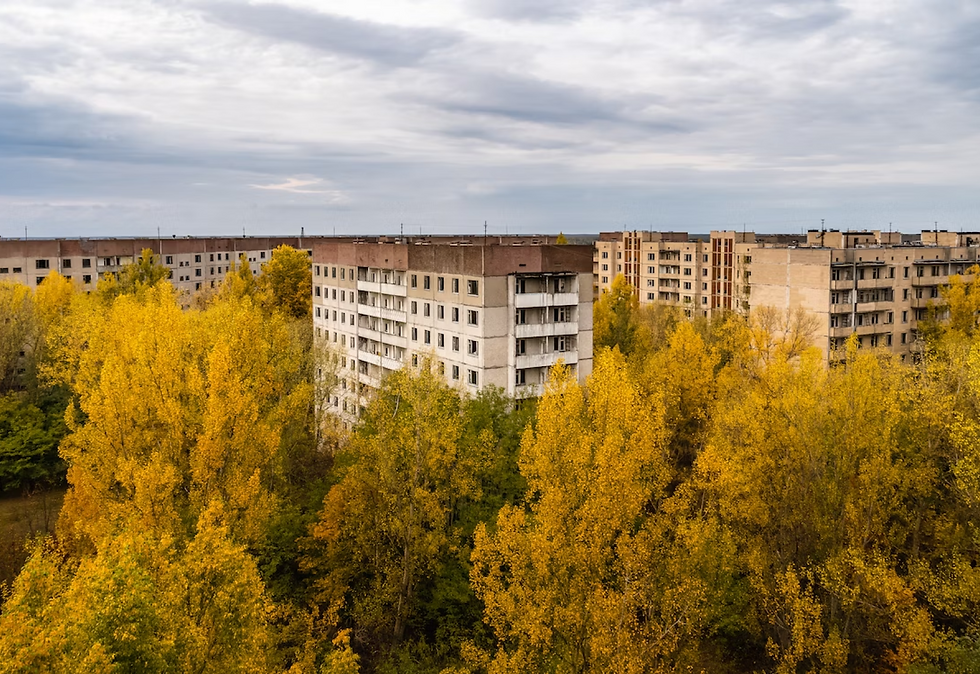
Chernobyl still bears the wounds of human negligence and lies, and the " Red Forest " and the " Bridge of Death " are the consequences of human crimes. The "Red Forest" is a memorial to the Chernobyl disaster. The forest, which was the first to be contaminated by radiation, and which even today cannot be viewed from close quarters, as it is still under the influence of radiation and dangerous for all living creatures. The "Bridge of Death" is a historical place that claimed many lives due to the government's lies about the Chernobyl disaster near the town of Prypiat. This bridge is the highest point of the town where people climbed on the night of April 26 to see the "burning roof of the Chernobyl nuclear power plant". This is the information that the inhabitants of the city knew about the disaster. But they did not know that the moment they stood on the bridge they received an enormous dose of radiation and that they would all die in a few days.
The whole world is in danger because of lies

An image of the radiation distribution map after April 26, 1986. Source: Bild.de
While the Soviet Union covered up the Chernobyl disaster, radiation spread across the continent and poisoned people's lives. In some places, people were unaware of the danger; elsewhere, they had already begun to counteract it with iodine and calcium tablets. In still other places, people were still being lied to and told that everything was fine. Further, you can read reports from people in Ukraine, Poland and two parts of Germany to learn the truth about what happened in neighboring countries after the Chernobyl disaster.
Tamara 74 years, from the city of Kharkiv (Ukraine)
At the time of the Chernobyl disaster, I was 37 years old and living in Kharkiv. A few days, maybe even a week, after the reactor at the Chernobyl power plant exploded, I knew nothing about the disaster. Firefighters and policemen were sent to Chernobyl to help, but the population did not know about the disaster until a large number of people began to die, not only in Chernobyl, but also in Kiev and neighboring cities. After a large number of deaths, the authorities told us only that a reactor at the Chernobyl nuclear power plant had exploded. I knew nothing about the radiation danger. My two daughters went to school and I went to work, so my life, in simple words, did not change after we learned about this disaster on television. Everyone continued to live as before, everyone worked and studied. There was no panic because nobody knew the truth, nobody understood that they were exposed to a great radiation danger. Everyone continued to live and work. Life did not change. After the collapse of the Soviet Union, I learned that Moscow had banned the dissemination of any information about the Chernobyl disaster, not only in Ukraine, but throughout the Soviet Union.
Jaroslaw 46 years, from the city of Swinoujscie (Poland)
The disaster happened when I was in the second grade of elementary school, I was 9 years old. We learned about it from a TV diary (as the news was called at that time). The first official information on TV and radio appeared on 30.04.1986, 4 days after the disaster. Of course, there was no panic, on the contrary, television and radio reassured people and reported that the whole situation was under control. I have no doubt that the Polish authorities did not know how serious the situation was. As for children, all elementary school students were gathered in classrooms and we had to take iodine tablets as a preventive measure to protect ourselves from possible negative effects of radiation. As an ally of the USSR, we were forced to accept this policy, especially since the USSR was very careful about releasing information and concealed more than it showed. On the other hand, of course, citizens understood what was happening. You know, in the 1980s, people associated a nuclear disaster mainly with a huge mushroom cloud over Hiroshima and Nagasaki, and adults were very worried. We kids didn't understand that.
Brunhilde 64 years, from the town of Heringsdorf (Germany)
When the disaster happened, I was 27 years old and lived in Heringsdorf in the GDR. I didn't have much information from the media, like radio or television. We were not told much about it and it was not dramatized. I knew it could be life-threatening, but I didn't know how much because we weren't told. What I remember is that there was more food than in previous years. There were more vegetables and fruits on the shelves, although before there was often a shortage of such products in the stores. I suspect that the goods became available because people in the West knew about the danger and therefore did not eat fresh vegetables and they were more strictly controlled. The media did not inform us about the full extent of the disaster and the possible impact on people's lives, probably out of fear of causing panic among the population. We were not informed about safety measures such as closing windows or taking iodine tablets, so I was not aware of the danger. Of course, it was talked about, but only very rarely and superficially. The topic of the Chernobyl disaster was not the first to appear in the news or on the radio. Because of the small amount of information, people did not panic.
Brigitte 80 years, from the city of Bad Salzdetfurth (Germany)
At the time of the Chernobyl disaster in 1986, I was 43 years old and lived in Glückstadt near Hamburg (FRG). On April 27, a newspaper appeared about the Chernobyl disaster and I also heard about it on the radio. The authorities talked about the problem and told us how to protect ourselves because the wind was carrying radiation that could be dangerous. I remember that the media advised us not to eat food from the forest, like meat or mushrooms, to keep the windows closed and to go outside less. I also remember demonstrations against nuclear power. But that was before the Chernobyl disaster. People were talking about this disaster, and we knew it could be life-threatening. I tried to go outside less and keep the windows closed, as the authorities said, but there was no panic among the population. I didn't take iodine tablets, and I don't remember if they were given to others.


Comments